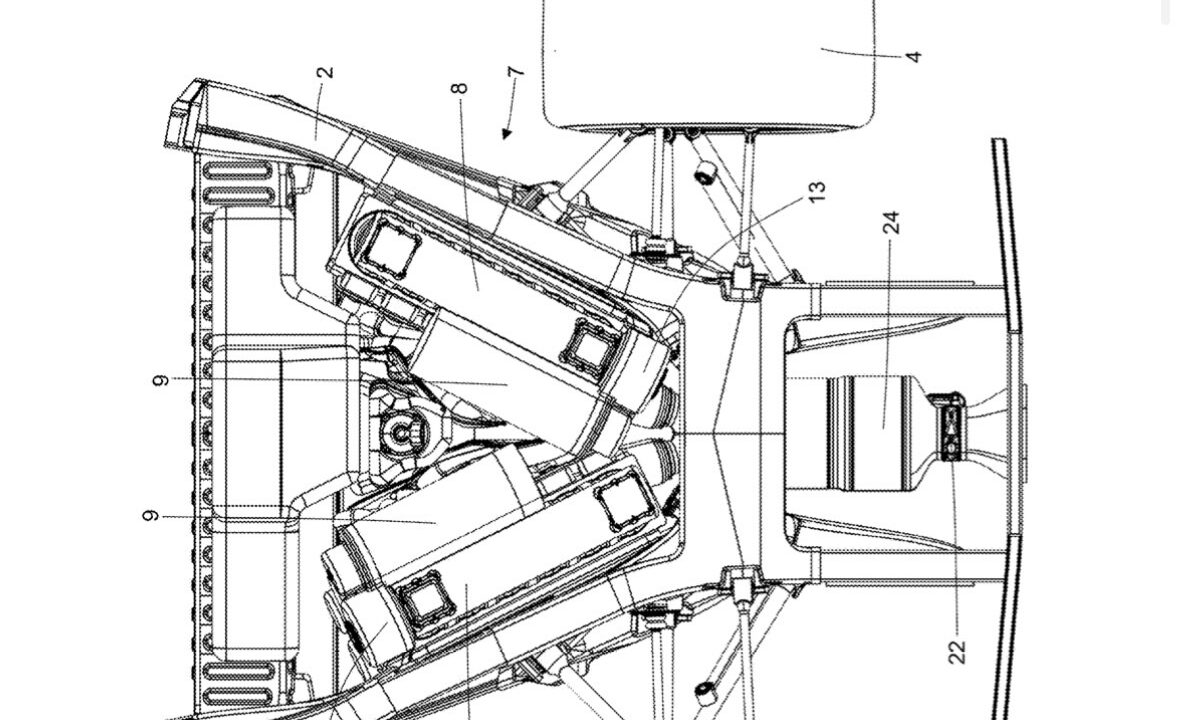
Ferrari’s US Patent number 2026/0077645, quietly filed with the United States Patent and Trademark Office, is one of those documents. And if even a fraction of what it describes eventually reaches a production car, it will represent one of the most significant shifts in Ferrari’s powertrain philosophy in the company’s modern history.
Let me explain what they’ve actually done here — in plain terms, without the patent jargon.
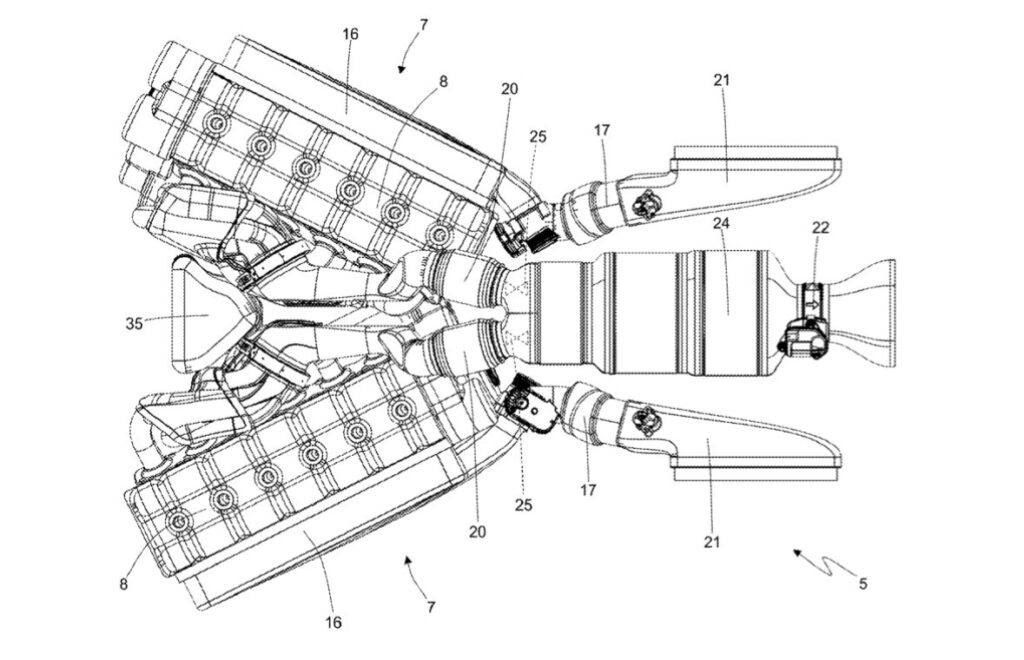
What Is Ferrari’s Dual Inline-6 Series Hybrid Powertrain?
At the core of this patent is a series-hybrid powertrain — a setup fundamentally different from the hybrids most people know. In a conventional hybrid like Ferrari’s own 296 GTB or SF90 Stradale, the combustion engine and electric motors share the job of driving the wheels. They work in parallel, like two workers pulling the same rope.
In a series-hybrid, that relationship is completely broken apart. The combustion engines are removed from the drivetrain entirely. They never touch the wheels. Their only job is to spin electric generators, which charge a battery, which then feeds electric motors that actually move the car.
Ferrari’s proposal takes this concept and builds something genuinely unusual on top of it: two separate inline-6 engines, arranged in a V-formation relative to each other. They sit low in the chassis, angled toward each other like the two banks of a V12 — but crucially, their crankshafts are not connected. They are fully independent mechanical units, each driving its own dedicated electric generator through a fixed-ratio transmission.
The result is a powertrain where two I6 engines exist purely as power sources for electricity generation, and two reversible electric motors at the rear axle handle everything to do with actually propelling the car.
No clutch. No multi-speed gearbox. No mechanical link between the engine and the road.
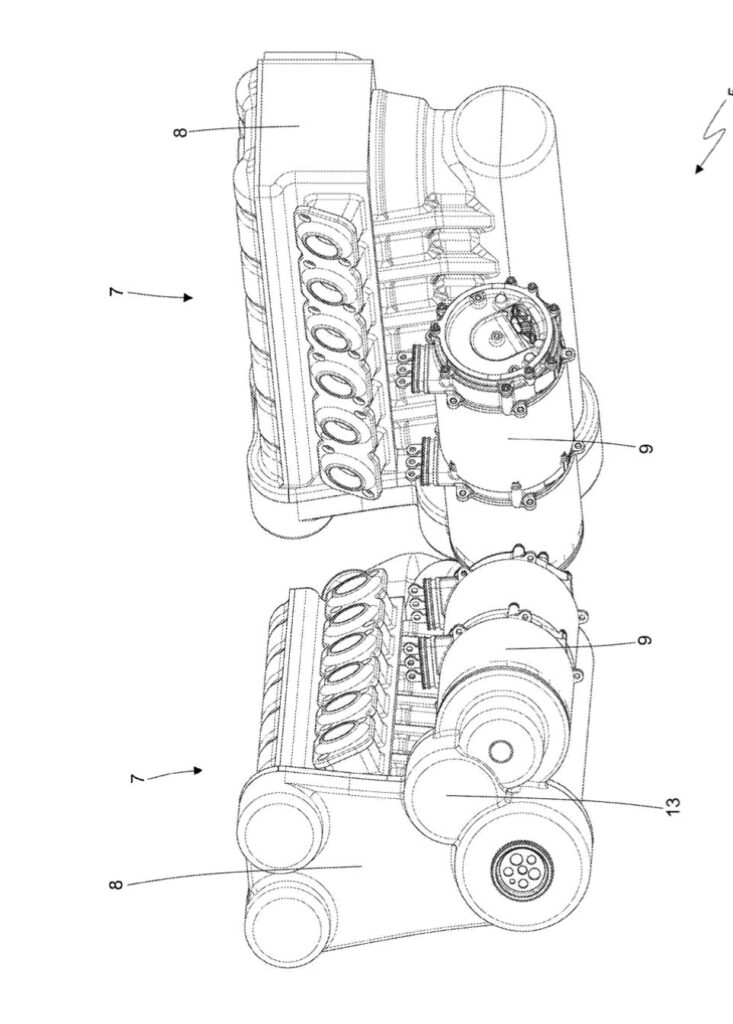
Why Two Engines? Why Not One Bigger One?
This is the first question anyone with engineering sense asks — and it’s the right one.
The obvious answer is packaging. Ferrari has spent decades obsessing over the centre of gravity in their cars. A low, centrally positioned mass is worth more to handling than almost any other single variable. Two compact I6 engines arranged in a V-formation sit lower and more centrally than a single large unit would. The overall profile becomes narrower, which also benefits aerodynamics.
But the less obvious answer is the more interesting one: efficiency.
In a traditional V12 — one of Ferrari’s most iconic powerplant formats — both banks of cylinders are bolted together and rotate as one unit. The engine spins at one speed. Both banks work at the same rate. There’s no flexibility there.
With two independent I6 units, each engine can run at its own optimal speed at any given moment. If the battery is well charged and the car is cruising, one engine can shut down entirely while the other ticks over at peak thermal efficiency. When more electricity is needed — during aggressive acceleration or to replenish a depleted battery — both engines can come online simultaneously at their most efficient operating points.
It’s the same logic that made twin-turbo setups smarter than single large turbos in the 1990s. Smaller, independent units each doing exactly what they do best, rather than one large unit compromised by having to do everything.
The Atkinson Cycle: A Small Detail That Deserves More Attention
Hidden within the technical language of this patent is a reference to the Atkinson cycle — and it tells you a great deal about how seriously Ferrari thought through this concept.
Most performance engines run on the Otto cycle — the standard four-stroke combustion sequence optimised for peak power output. The Atkinson cycle modifies this by making the expansion stroke longer than the compression stroke. The engine extracts more energy from each combustion event, wastes less heat, and operates more efficiently overall. The trade-off is that it produces less raw power per unit of displacement.
For a conventional sports car engine, that trade-off is unacceptable. But for a generator engine — one that never needs to deliver power to the wheels directly, only to spin a generator at a steady, optimised RPM — the Atkinson cycle is nearly ideal. You want efficiency above all else. You want the engines to run consistently, quietly, and without wasting fuel.
Ferrari’s choice of the Atkinson cycle for these generator I6 units is not an accident. It is a deliberate engineering decision that shows the team understands exactly what these engines are being asked to do, and has matched the combustion strategy accordingly.
The Shared Lubrication Circuit: The Detail Nobody Is Talking About
Most of the coverage around this patent has focused on the V-formation layout and the generator-only function of the engines. But there’s a detail buried deeper in the filing that I find equally significant: the two engines share an interconnected lubrication circuit.
At first glance, this seems like a cost-saving measure — one oil system instead of two. And yes, it simplifies the packaging. But the more important implication is thermal.
Oil is not just a lubricant. It’s a thermal transfer medium. When two engines share an oil circuit, the heat generated by the harder-working unit is partially distributed to the lighter-loaded one. This smooths out temperature differentials between the two engines, reduces thermal stress on components, and extends the operating life of seals, gaskets, and metal surfaces.
For a performance application where one engine may be running hard while the other is barely ticking over, this interconnected lubrication approach is genuinely clever thermal engineering — not a footnote.
How This Compares to Current Ferrari Hybrids — and What Changes
Ferrari’s current hybrid lineup operates on what engineers call a parallel hybrid architecture. In the 296 GTB, a twin-turbocharged V6 sits mechanically connected to the rear wheels through a gearbox. An electric motor sits between the engine and the gearbox, adding torque when needed. The engine and motor work together — in parallel.
This architecture is excellent for performance. It is less ideal for efficiency and simplicity, because you still need a gearbox, a clutch, and all the mechanical complexity that connects the engine to the road.
The series-hybrid architecture in this patent eliminates almost all of that complexity on the drivetrain side. There is no gearbox connecting the engines to the wheels. The electric motors deliver torque directly and instantly across their full rev range — which is one of the defining characteristics of electric motor performance. The engines only need to be optimised for steady-state generator operation, not for the wildly variable demands of a road car drivetrain.
The trade-off is that the system depends entirely on the battery and power electronics to manage energy flow. The combustion engines become infrastructure — always available to generate electricity, but never directly in the loop of driver inputs and wheel response.
Extended Range, Not Just Hybrid Range
One of the most practically significant aspects of this powertrain is what it means for range. Current Ferrari hybrids offer electric-only range measured in the low tens of kilometres — enough to exit a zero-emissions zone silently, but not enough for meaningful daily electric driving.
A series-hybrid architecture with two dedicated generator engines changes this calculation entirely. The car can operate indefinitely in pure electric mode as long as the engines are running to replenish the battery. The effective range becomes limited by the fuel tank, not by battery capacity alone. This is the same principle behind the Ram 1500 REV — an American pickup that combines a large battery with a generator engine and projects a total range exceeding 1,100 kilometres.
For a Ferrari, this would represent an entirely new kind of ownership experience. Silent, electric performance on demand — with the knowledge that the engines are there, humming efficiently in the background, ready to keep the battery charged across any distance.
Will This Patent Become a Real Ferrari?
Honestly? Not necessarily — and it’s important to say that clearly.
Manufacturers file patents constantly. Some represent active development programmes. Others protect concepts that may never progress past a drawing board. And some are filed simply to maintain intellectual property coverage in a space the company is watching carefully.
What distinguishes this patent from a speculative filing is the depth of engineering specificity. The Atkinson cycle selection. The interconnected lubrication circuit. The fixed-ratio generator connection. These are not high-level conceptual sketches — they are worked-out engineering decisions. Someone spent real time on this.
The broader industry context also suggests Ferrari is watching the EREV space seriously. Extended-range electric vehicles have moved from a niche concept to a mainstream format in less than a decade. The logic of combining electric driving quality with combustion-engine range reassurance is compelling, and several major automakers are now committed to it.
If Ferrari does bring a version of this to production — likely in a hypercar or limited-series context in the early 2030s — it would be architecturally unlike anything currently wearing the Prancing Horse badge. The engines would be there. You would hear them. But they would not be driving you. They would be powering the motors that drive you. That is a meaningful philosophical shift, and Ferrari’s engineers clearly know it.
